Armenian Presence in Lebanon: Cultural Specifications Inquiry
Submission Date :2024-02-22 | First Published : 2024-04-15 | Written In : English
Taline Ekizian Kalanderian
Abstract
Questioning the personal identity as an Armenian born in a host land became the gate of a mental and an emotional journey, projecting all the cultural practices that are unseen in the district of Bourj Hammoud due to lack of space for education. It’s been more than 100 years now, that the city of Bourj Hammoud has been marked by its strong community identity, a thriving mix of modern trades and traditional crafts, home to a vibrant community of Armenians: traders, artisans and artists. The simple camp canvas at the north east entrance of the Lebanese capital, that was painted of refugees who fled Turkey in 1915, is now transformed into an urban economic center and activity. Rising from the ashes, the Lebanese-Armenian people have managed to survive, clutching at their Christian faith for which they were massacred, maintaining the Armenian language, building churches in the fatherland Lebanon, establishing schools and cultural organizations. The latter show not only the survival of a community and its history, but also the mentality of a community that desires to live abundantly. On its’ streets, the vernacular culture provides a currency of economic exchange and a language of social revival. This Armenian community is a reservoir of history with men and women who deposit experiences, beliefs, dreams, emotions and visions. A vast culture that supplies symbols, patterns and meaning for nearly all the service industries, that’s also intertwined with capital and identity. However, as decades pass by, the Armenians of the diaspora stop practicing some of their cultural specifications, due to the inconveniences of being a “Minority Group in Exile”, such as lack of enough spaces to practice traditions like carpet weaving, in addition to the truth of the matter of coexisting in two different cultures, which fuses the thoughts and ideologies of the Armenian community individuals with the other community’s thoughts and ideologies, and this presses against the core of the Armenian culture. Thus, the recent and the coming generations will have lesser awareness of what the previous generation knows and practices. And so, this leads to the mutation of a culture and its identity. Off course, change is the unchangeable part of the living and progressing, it is good and it induces enrichment, especially when it comes to exchanging cultures; however, not knowing or not being aware of the core culture of one’s origin threatens the healthy transformation of the historical truth and creates a blurred image of it in the first place.Henceforth, the aim of this article is to highlight the Armenian cultural specifications that are not widely practiced in Lebanon.
1.INTRODUCTION
What is the identity of a person who was born and raised in a host land and not in his/her homeland? Shall this person carry the culture of the unseen country or that of the seen or both? Isn’t then already the homeland’s culture blurred?
Kurt Lewin (social psychologist):“In the framework of Lewinian field theory, simultaneous participation in two coextensive cultures exposes an individual to influences from two overlapping psychological situations”.[1] To further shed light on the preamble, if people of different ethnicities and cultures are to harmoniously walk the same streets, shop in the same shops, go to the same schools and vote in the same elections, this creates overlapping psychological situations that originate from coextensive cultures – the culture of the homeland and the culture of the host land-which also arouse desires to maintain the original culture and to seek interaction with the other culture.[2] From here one can say, that the homeland’s culture is prone to take different stances and forms due to friction with the context culture…
Lebanon is a complex mosaic of heterogeneous groups, where Armenians form 8 percent of the total population.[3] I am an Armenian, I was born and raised in Lebanon. I grew up speaking Armenian with my family members and in the district of my residence (Bourj Hammoud). I learned Arabic at school, however I only came to know how to speak it correctly as I started working part time jobs, mingling with the Lebanese society. Throughout years of interaction, I have heard Lebanese people often ask me common questions:
- Why Armenians can’t speak Arabic well and commit gender mistakes?
- Why the moment two Armenians are together, they revert to speaking Armenian to each other and alienate the others?
- Are you from Bourj Hammoud?
- What is it that Armenians commemorate on April 24?
- Are the Armenians supposed to eat Basterma and Sujuk?
- Do all Armenians have ‘ian’ added to their surname? Why?
Though more than 100 years of living together, Lebanese people know not much about Armenians.[4] However, deep down in my heart relentless waves of questions come up to my chest and with a deep breath the same statement made about the Lebanese people now is referred to me as I ask myself the following: Do I know much about Armenians? Do the Lebanese-Armenians know much about Armenians? Do I feel like I’m more Armenian or Lebanese? Do the Lebanese-Armenians feel like they are Armenian or Lebanese? Both or neither?
During my summer vacation visit to Armenia in September 2019, I discovered so many cultural richness in my homeland that I didn’t know about at all. As William Saroyan stated:“I’m no Armenian. I’m an American. well, the truth is I am both and neither. I love Armenia and I love America and I belong to both, but I am only this: an inhabitant of the earth, and so are you, whoever you are. I tried to forget Armenia but I couldn't do it”.[5]
Likewise, if Lebanese-Armenians feel both Lebanese and Armenian or neither of them, then what will maintain the cultural specifications of Armenia years from now? How will I?
This personal lifetime experience of mine has made me wonder, had there been creative places reviving the core history, traditions, ideologies and culture of the homeland, Armenia, would there be new behaviors with extraordinary results?
The challenge is to bring back the forgotten cultural specifications of the Armenians, to reflect the current image of the remnant Armenian culture and to excite interaction together with the Lebanese society and other communities.
2.THEME: HISTORY OF ARMENIANS IN LEBANON
2.1 Definitions
2.1.1 Meaning of Culture
Culture is one of the two or three most complicated words in the English language partly because of its intricate historical development, in several European languages.[6] Moreover, culture is a source of images and memories, it symbolizes “who belongs” in specific places, thus culture supplies the basic information- including symbols, patterns, and meaning- for nearly all the service industries. Meanwhile in government and finance, culture is more and more the business of cities- the basis of their tourist attractions and their unique competitive edge. The growth of cultural consumption (of art, food, fashion, music, tourism) and the industries that cater to it fuels the city’s symbolic economy, its visible ability to produce both symbols and space.[7]Thereafter, culture is intertwined with capital and identity in the city’s production systems.
2.1.2 Meaning of Multicultural Integration
Multicultural or socio-cultural integration happens between people, not between groups, who meet and interact in shops, at work, in school, or during leisure time. Some contacts may be instrumental in creating mutual understanding, others may develop into friendships, and some may be conflictual. Whatever the specific outcome, it deals with interindividual social processes.[8
2.1.3 Socio-Economic Impact of Multicultural Integration
Multicultural integration is the “acceptance” of immigrants adopting the culture of the majority and the “acceptance” of the minority maintaining their own culture, that is to say it encourages people to reflect on their cultural values, norms, practices, institutions, etc. and this regardless of the very fact of their diversity.[9]
“Multicultural integration might seem to be foremost a structural issue affecting large groups and societies and can possibly be relatively well understood using social and economic variables. Clearly, there are many psychological aspects to education, social status, occupational life, etc.”.[10]This very process is not only related to utilitarian reasons, but also to issues of identity, cultural beliefs and religion.
2.2 Armenians in Lebanon
2.2.1 Surge of Armenians into Lebanon
The presence of Armenians in Mount Lebanon goes back to the middle ages. However, the surge of recent immigration into Lebanon commenced in the late 19th century as the Ottoman government increased its oppression against Armenians in Turkish-held Armenia and other minorities throughout the Empire. The Contemporary Armenian community in Lebanon came into being only after the 1915-16 massacres (Figure 1). The last major move came from Syria in the years between 1959 and 1966.
The presence of Armenians on the Lebanese socio-political scene was legitimized when they obtained citizenship in 1924 according to the stipulations of the Treaty of Lausanne.[11] By 1926 there were some 75,000 Armenians in Lebanon and the Lebanese Constitution granted them and other minorities civil rights to elect their own members of parliament. The country’s geographic location and the security offered by the French, as well as its Christian-dominated government attracted more Armenians there. In 1930 the Catholicosate of Cilicia moved to Antelias, outside of Beirut (Figure 2).[12] However, the Catholicosate of Cilicia in Antelias was to become more than the spiritual center of the orthodox community; a symbol for all the Armenians of Lebanon and diaspora. It is the rebirth of Cilicia on the shore of the eastern Mediterranean.[13]

|
Fig. 1: Armenians from genocide to survival, images from multiple internet sites, 2020, image photoshoped byEkizian, T. |

|
Fig. 2: The Catholicosate of Cilicia in Antelias, Lebanon, La Nouvelle Cilicie, 1999, Iskandar Jules, A. |
2.2.2 Armenian Refugee Camps
The following are the formations of the Armenian refugee camps in Lebanon, also illustrated in figure 3and on the next page figure 4.

|
Fig. 3: Map Location of Armenian refugee camps and industrial zones, ARMENIANS OF LEBANON: From Past Princesses and Refugees to Present-Day Community, 2009, Boudjikanian, A., cartography: Boudjikanian, A. |
Camp Saint Michel in 1921: The majority of the first refugees from cilicia get located in the grand camp Saint-Michel near the beirut port, dwelling in tents with many diseases detected.
The Quarantine Camp in 1923: To the east of the existing camp at the Beirut port, a new camp established called Quarantina Camp. The Armenians organized themselves in the latter as in their cities of origin (Marach, Adana, Sis, Hadjin).
Achrafiye Hills in 1927: Quarters for the Armenians in the Achrafiye hills were built, in th area later to be ''Les Pavillons Blanches'', housing mostly Armenians

|
Fig. 4: Armenian refugee camps in Beirut, The Armenian Quarters in Beirut, Bourj-Hammoud and Karm El Zeitoun, 2009, Hediger, D. and Andrej, L. |
working as artisans or people whose state of health doesn’t allow them to stay in camps anymore.
The Nor Marach Camp In 1930:The fisrt of the associations to become active in order to buy land is the one of the small town of Marach. Collecting money from its memebers, buys a piece of land in Bourj Hammoud and calls it Nor Marach (new Marach). The area gets planned and parceled as a dense grid by an Armenian architect. The construction of the dwellings is done by the refugees themselves.
The Camps in Early 1930s: Following the example of nor marach, the other major Armenian associations repeat the model of collectively buying land and the distribution of small plots to the families. Within the first half of the 1930s, on the western side of Beirut river in Bourj Hammoud, Nor Adana, Nor Sis, Trad, Gulabachene, Parechene, Ekbes and Norchene get constructed.
Camp Sandjak 1939: Following the handOver of the Alexandrette region to the turkish republic, many settled in Bourj Hammoud. Unlike the other new Armenian settlements, the Sandjak area is much more alike of the camps in Quarantina and forms an unplanned and informal belt to the north of the regular quarters. This camp existed with varying populations, until 2009, afterwards its demoltion started to take place for new mixed development.[14]
2.2.3 Armenians in Bourj Hammoud
After 1928, Armenian refugees who had survived the Ottoman persecution started settling in the district called Bourj Hammoud, the geographical extension of Beirut City along the Mediterranean coastline, separated from it by the Beirut River. Until early last century, Bourj Hammoud was an agricultural area and marshlands, with scattered individual settlements. However, the immigrant Armenians organized themselves in regular gridiron patterns in compact quarters (Figures 5 and 6), each populated by natives from a village in their original homeland, which gave its name to each new quarter, constituted from nine quarters: Shatiq-al-bahri (coastal zone), Dora, Haret-Sader, Marashe, Nor Adana, Nor-Sis, Mar-Doumit, Nabaa, Ghilane.[15]

|
Fig. 5: Armenian refugee camps in Beirut, The Armenian Quarters in Beirut, Bourj-Hammoud and Karm El Zeitoun, 2009, Hediger, D. and Andrej, L., image photoshoped by Ekizian, T. Fig. 6: Plan of the Gullabachèn district, in Bourj Hammoud, drawn up by the architect Mardiros Altounian, ARMENIANS OF LEBANON: From Past Princesses and Refugees to Present-Day Community, 2009, Boudjikanian, A. |
After 1946, Bourj Hammoud started attracting emigrants from the south, mainly Shiites and some Palestinians, who settled mainly on the southeastern edges of the district (Nabaa), while in the sixties it witnessed an influx of Armenians from Syria, mainly Aleppo, who settled in the area and established their small businesses. The district is generally considered as a popular area, that has evolved from a settlement with makeshift shelters to a densely populated area, an active commercial pole and an industrial and handicraft activities hub.[16]
2.2.4 History of Lebanese-Armenian Religious, Political, Social, Economic and Cultural Integrations
In the early 1920s, Lebanese-Armenians were largely a community of refugees, detached from Lebanese society. By the departure of French troops from the Levant in 1946, Armenians were no longer an alien element in Lebanon, and when the First Lebanese Civil War broke out twelve years later, they had become “a fully integrated national minority group”.
“Lebanon, for many Armenians, is referred to as “our second homeland” (yergort hayrenik), and it is scarcely difficult to see why. As nowhere else in the regional diaspora, Lebanon has offered its Armenian citizens—initially refugees—the economic freedom to achieve prosperity, the political freedom to pursue their interests, and the communal autonomy to preserve their identity. These freedoms and the efflorescence that they have enabled—to say nothing of Lebanon’s singularity as the scene of unique Armenian ecclesiastical and cultural institutions—have made Lebanon a distinctive part of the Armenian diaspora”.[17]
- Lebanese-Armenian Religious Integration
Two further happenings in the years that followed, contributed to Lebanon’s importance in the Armenian diaspora and to the acclimation of Armenians in the country. First, in 1928, the headquarters of the Armenian Catholic Church returned to Lebanon. The second was the relocation to Lebanon of the Catholicosate of Cilicia, that had been in Sis (Kozan in modern Turkey), but in 1930, it moved to Antelias, north of Beirut, where it has remained ever since.[18]
- Lebanese-Armenian Political Integration
The move to Lebanon of the Armenian Catholic Church and the Catholicosate of Cilicia coincided with the earliest stage of Armenian political participation in Lebanon in 1925.[19] The Lebanese census of 1932, legitimized the anticipatedrole of the Armenians in the political power structure of thecountry, giving the Christians a 6 to 5 dominant ratio overthe Muslims. Initially, the legal integration of Armenians led to theprogressively greater acceptance of the Armenian communityby the Arab Christians on the one hand, and to the greatertendency by the Armenians to borrow from the Arab Christianculture, on the other. The Arab-Armenian relations were dynamically related to their constantly evolving competitive-cooperative relationship with regard to political and economic resources.[20]
- Lebanese-Armenian Social Integration
The Lebanese president Camille Chamoun (1952-1958) addressed the Lebanese-Armenians during his incumbency: “You should consider yourself in your own home, since it is without exaggeration when I say Lebanon is a second Armenia”.[21]
Also in the fifties, Raymond Eddé, another of Lebanon’s leading statesmen in the twentieth century, spoke of “Armenians of The Lebanese Family”.[22]
Along with political and economic integration, social integration came too. A mutual decrease in social distancebetween the Armenians and the Arab Christians was observedbetween 1935 and 1952. Furthermore, they demonstrated growing openness through greater intermarriage, and internalization of manifest needs and personality characteristics. Thus, cooperation and self-interest has affected the evolution of the Arab-Armenian relations in Lebanon.[23]
- Lebanese-Armenian Economic Integration
Just as Armenians integrated into the Lebanese political system, so they integrated into the Lebanese economy. The Armenians have prospered as much in the Lebanese economy as they have contributed to it. Perhaps with some measure of exaggeration, one observer noted in 1975, that Armenians form approximately eight percent of the Lebanese population, while their contribution to the national income of Lebanon is fifteen percent and their per capita income however, was forty percent more than the Lebanese national average. Furthermore, Armenians thrived in Lebanon as artisans, merchants, and professionals of every variety, winning a reputation in Lebanese society for their industry and honesty.[24]

|
Fig. 7: Arpi Mangassarian, former head of the Architecture and Urban Planning Department of the Bourj Hammoud municipality, at Badguer, Portraits of Survival: The Armenians of Bourj Hammoud, 2014, Delacampagne, A. |
- Lebanese-Armenian Cultural Integration
One of the distinctive features that gave the Lebanese Armenian community this centrality in the diaspora was its cultural endeavor. In 1924, Nor Piunik, the first Armenian newspaper in an Arab-defined country went to press, and by 1944, fiftyseven Armenian publications were being issued in Lebanon.Lebanon’s three main political parties each brought out their own dailies and the country’s Armenian churches, their own recurring publications.
The Armenians of Lebanon have been free to attend their own schools, to speak and teach their language, to maintain their communal organizations, to profess their religions, and to bring out their own publications—all without hindrance. Such is the example of Arpi Mangassarian, who established Badguer (Figure 7), a small cultural space for Armenians to manintain their cultural and traditional practices.
The Lebanese Armenian poet Mushegh Ishkan, in an article titled Lebanon: The Central Fortress of Culture in the Diaspora, proclaimed: “Nobody can ever deny that Lebanon is the cultural and educational center of the Diaspora. It has become a kind of modern era Yerkir—homeland.” Also, no less a personage than Vazgen I, the Catholicos of the Armenian Apostolic Church (1955-1994), once pronounced “Lebanon the seat of our brightest community.” [25]
3. ARMENIAN CULTURAL BACKGROUND INFORMATION
3.1 Armenian Culture
The culture of Armenia encompasses many elements that are based on architecture, sculpture, cross-stone, textile, carpet, embroidery, wall painting, illuminated manuscript, mosaic, ceramic, metalwork, literature, music and dance. Moreover, whether a stone cathedral, a manuscript miniature, a cross-stone, or an embroidered chalice cover, every object is displayed as an artistic beauty based on color or line and as an inner symbolic glory of Christian faith based on its meaning or use.[26]
Of all the arts, architecture is supreme and it was the first of the arts of Armenia to be seriously studied. To this day Armenian architecture receives more scholarly attention than all of the other arts combined.
3.1.1.1 Pre-Christian Architecture in Armenia and the Place of the Church
The history of Armenian architecture is in reality the history of the development of a single type of building: the church. However, very sophisticated building techniques were in use in Armenia and a strong architectural tradition in stone was exercised for more than a thousand years before the first church was built.
Urartu: Unfortunately, only a handful of pre-Christian examples has survived and they are from three distinct epochs: Urartian, Hellenistic, and late Roman. A considerable number of temples and fortified garrison cities are known belonging to the kingdom of Urartu, the most famous examples being the garrisons of Erebuni (Figure 8) and Karmir Blur (red mountain) in Soviet Armenia.
Garni: At the site of Garni (Figure 9), a number of important constructions survive from three different periods. The oldest is made up of a number of defensive walls around the locality, dating to the first century before Christ. The second period is represented by the splendid temple of Garni, following the general design of a Greco-Roman temple so characteristic of the Mediterranean world.[27]

|
Fig. 8: Erebuni, Urartian fortress, Erevan, VIIIth-VIIth centuries B.C., The Arts of Armenia, 1995, Kouymjian, D., photo: Donabedian, P. |

|
Fig. 9: Garni, Pagan Temple in Hellenistic style, First century, L'Art Arménien, 1977, Der Nersessian, S. |
3.1.1.2 ArmenianArchitecture as Church Architecture
Armenian architecture is essentially that of church buildings, thus a Christian architecture, due to the lack of secular constructions: palaces, fortresses, bridges, houses, etc., since common dwellings were made of perishable materials, wood, mud brick, or simply dug into the ground or a hillside. The excavations of the medieval capital city of Ani, confirm the lack of substantial dwellings that could be considered architectural monuments.
Armenian architecture achieved a distinctive style through the combination of a number of common characteristics and materials. First, churches are built in stone, volcanic tufa abundant in Armenia in many colors and shades. Second, the dome or cupola elevated above the other vaulted ceilings by a cylindrical drum (usually polygonal on the outside). The prevalence of the dome forced architects to think in terms of centrally planned buildings (Figures 10 and 11). Third, roofs were composite in their appearance because they had to cover the vaults.[28]
|
Fig. 10: Centrally planned Armenian church buildings, L'Art Arménien, 1977, Der Nersessian, S. |

|
Fig. 11: Centrally planned Armenian church buildings, L'Art Arménien, 1977, Der Nersessian, S. Centrally planned St. Hripsime church plan, Armenia: A Historical Atlas, 2001, Hewsen, R. |
Of the most important churches in Armenia are Hripsime and Etchmiadzin (figures 12 and 13).

|
Fig. 12: St. Hripsime, archetype of radiating plan, four apses, with three-quarter cylinders and square corner chambers church perspective and section, 618 B.C., The Architecture of the Armenians and of Europe, 1918, Strzygowski, J. |

|
Fig. 13: Etchmiadzin, Cathedral, niche-buttressed square plan, reconstructed in 485, restored in the VIIth and XVIIth centuries, https://www.tripadvisor.com.sg/ShowUserReviews-g666440-d5504450-r405329280-Echmiadzin_Monastery-Vagharshapat_Armavir_Province.html |
3.1.2 Sculpture
Little sculpture has survived from the pre-Christian period because of the destroying of all vestiges associated with earlier pagan religions by St. Gregory and the newly convert royal court of Armenia. The Armenian sculpture can be classified as follows:
Relief Sculpture: In Christian times relief sculpture on the elevations of churches is very abundant. The most famous being the tenth century church of the Holy Cross, built between 915 and 921, on the island of Aghtamar (Figure 14).

|
Fig. 14: Relief carving, Aghtamar, church of the Holy Cross, West façade 915-921, The Arts of Armenia, 1995, Kouymjian, D., photo: Kouymjian, D. |

|
Fig. 15: Four sided pedestal, Virgin and Child with Angels, T’alin Cathedral, Vth century, The Arts of Armenia, 1995, Kouymjian, D., photo: Kouymjian, D. |
Carved Stelae: There is also a large body of free-standing stone monuments in the form of either four-sided stelae or the ubiquitous khachkars (Cross-Stones). The stelae are found on the grounds of churches; the most famous group still in part in situ is at T’alin (Figure 15).[29]
3.1.3 Khachkar / Cross-Stone
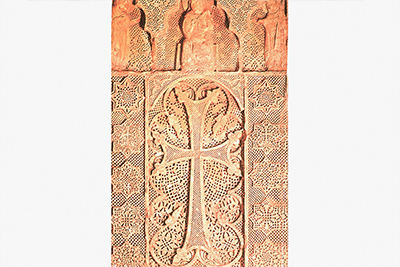
The most characteristically Armenian medium for sculpture is the khachkar, from the word cross (khach) and stone (kar). These free standing, rectangular shaped cross-stones are found everywhere in Armenia; there are thousands of them in all sizes from forty centimeters to two meters high and more. Without exception the central motif is a cross, elaborately and elegantly carved. Smaller khachkars are often found inserted into the walls of churches, and placed at church doorways (Figure 16). Like the stelae of the earlier centuries, they were used both as gravestones and as commemorative markers. The best known sculptor of khachkars, Momik (Figure 17), lived at the end of the thirteenth century; an artist of impressive skill he was also a noted architect and miniaturist.[30]

|
Fig. 16: Khachkar, 1308, sculpted by Momik, from Noravank, now at Etchmiadzin Catholicossate, The Arts of Armenia, 1995, Kouymjian, D., photo: Kouymjian, D. |
|
Fig. 17: Khachkar, 1291, sculpted by Boghos, Goshavank, Armenian Folk Arts, Culture, and Identity, 2001, Petrosyan, H., photo: Sweezy, S. |
3.1.4 The Sacred Mountain: Mount Ararat
Among the many peaks and mountains in the Highland, a massive mountainrisesupfromtheAraratplain,visiblefrom many sites in today's Armenia and appearingclose to the capital city ofYerevan (see Figure 18).This mountain is known to the world as Ararat, but its’ twin peaks have long been sacred to Armenians as Greater and Lesser Masis.For Armenians, the mountain's presence has inspired their awe and influenced their thought (Figure 19).[31]

|
Fig. 18: Mount Ararat, Armenian Folk Arts, Culture, and Identity, 2001, Petrosyan, H., photo: Sweezy, S. |

|
Fig. 19: Mount Ararat Paintings, Vernisage, Armenian Folk Arts, Culture, and Identity, 2001, Petrosyan, H., photo: Khachikyan, Z. |
4. CULTURAL ARTIFACTS AND HERITAGE
4.1 Armenian Textiles
The complex history of Armenian weaving and needlework was acted out in the Near East. Few are the people who, like the Armenians, can claim a continuous and consistent record of fine textile production from the time of the ancient Assyrians to the present.
4.1.1 Costumes
The earlier costumes of the ancient and medieval Armenian periods are based entirely on representations in Armenian art, especially manuscript illustrations. The oldest existing Armenian costume is found at Ani. Liturgical garments, preserved from the seventeenth and eighteenth centuries (Figures 20 and 21), but almost no secular examples exist.[32]

|
Fig. 20: Embroider cope of velvet, XVIIIth century, Etchmiadzin, Treasury, The Arts of Armenia, 1995, Kouymjian, D., photo: Gulbenkian Foundation Archives |

|
Fig. 21: Priestly vestments, embroidered with silver thread, XVIIIth and XIXth centuries, Etchmiadzin, Treasury, The Arts of Armenia, 1995, Kouymjian, D., photo: Güler, A. |

|
Fig. 22: Artsakh (Karabagh), three line Armenian inscription of 1917, The Arts of Armenia, 1995, Kouymjian, D., photo: Amirian, L. |
4.1.2 Carpets
Carpets are mentioned as part of the annual Armenian tribute to the Caliph of Baghdad in the late eighth century. The Armenian province of Artsakh (Karabagh) has retained the dragon design into modern times, reinforcing the Armenian origin of seventeenth and eighteenth century examples. A number of these dragon rugs have Armenian inscriptions. During the dislocation of the first World War, the production of Armenian hand loomed rugs nearly ended as did that of so many other crafts. Some survivors, however, continued to weave Armenian rugs until World War II (Figure 23). Furthermore, the wholesale destruction of Armenian life and property in Anatolia and western Armenia from 1915 to 1922, resulted in the loss of heirloom Armenian rugs passed down in families. The earliest dated Armenian rug is also one of the largest and most exquisite, the famous Kohar carpet made in the Karabagh (the Armenian district of Artsakh) with an inscription identifying the weaver, Kohar, and the date 1700 (Figure 33). Other Karabagh types are popular: Kasim Ushak design, cloudband design (Figure 24), jagged red band design, lempe/lampa design, Lesghi star design, etc.[33]

|
Fig. 23: Gohar carpet, 1700, The Arts of Armenia, 1995, Kouymjian, D., photo: Armenian Rugs Society. |

|
Fig. 24: Dragon carpet, Artsakh (Karabagh), XIXth century, Erevan, The Arts of Armenia, 1995, Kouymjian, D., photo: Museum of Folk Art |
4.1.3 Needle Lace and Embroidery
Richly embroidered Armenian textiles have survived in much greater number than plain or printed fabrics. These embroideries are mostly church related: clerical robes and accessories, altar curtains, chalice covers, and miscellany. Among the vestments are miters, crowns, copes, stoles, collars, belts, sleeve bands, chasubles, and slippers. Major collections with pieces dating from the seventeenth to the twentieth centuries are kept in the monasteries of Etchmiadzin (Figure 25), Jerusalem, the Mekhitarists in Venice and Vienna, Bzummar in Lebanon and other centers. Rich figural designs on silk, velvet, satins and more modest materials are sewn in vivid colors, the most lavish employ gold and silver thread,pearls and other precious and semi-precious stones. The most famous embroidery is the ceremonial banner of 1448 (Figure 36), still kept at Etchmiadzin, with full-length portraits of Gregory the Illuminator flanked by King Trdat and St. Hripsime, the major figures responsible for the Armenia conversion to Christianity.[34]

|
Fig. 25: Embroidered vakas, priestly collar, XVIIth century, Etchmiadzin, Treasury, The Arts of Armenia, 1995, Kouymjian, D., photo: Güler, A. |

|
Fig. 26: Embroidered processional banner of 1448, Etchmiadzin, Treasury,The Arts of Armenia, 1995, Kouymjian, D., photo: Kouymjian, D. |
4.1.4 Wall Paintings / Frescoes
In the history of monumental painting in Armenia, there follows a hiatus of more than a thousand years. In the late sixth and early seventh centuries of the Christian era, some churches were decorated with frescoes in their apses. The most important, the most extensive and the best preserved are in the palatine church on the island of Aghtamar in Lake Van, the entire interior of this church from floor to dome was painted with an extensive New Testament cycle as a complement to the Old Testament one, carved on the exterior façade of the church.[35]
4.2 Illuminated Manuscripts
4.2.1 Painting: The Art of Illumination
The history of Armenian painting is known almost exclusively from the study of the decoration of manuscripts. Fortunately, a very large number of Armenian manuscripts are preserved, more than 31,000, dating from the ninth to the nineteenth centuries, and produced in every region inhabited by Armenians. T'oros Roslin is among several important Armenian artists. We find native or Armenian styles in the Vaspourakan school of the fourteenth and fifteenth centuries, or in such early manuscripts as the Gospel of 966 in Baltimore, or the Gospel of 1038 in Erevan, or of 1064 in Jerusalem.[36]

|
Fig. 27: St. Mark,The Arts of Armenia, 1995, Kouymjian, D., photo: Güler, A. |
4.2.2 The Production of Manuscripts
In the medieval Christian world of which Armenia was a part, artists as architects were usually anonymous and usually members of the clergy. Manuscript production was carried on exclusively by monks or priests, employed in churches or monasteries. The performance of the church service was dependent on liturgical books, foremost of which was the Gospels, and, therefore, there was a constant need for them. Each monastery had its scriptorium where manuscripts were copied, illustrated and bound by a team.There is really only a single subject for Armenian miniature painting, at least until the late medieval period: The Life of Christ. The single work most reproduced in the Armenian manuscript tradition was the Four Gospels. With few exceptions, all of the surviving, illustrated Armenian manuscripts dated before 1300 were Gospels. It was customary, at least for illustrated Gospels, to include a portrait of each of the Evangelists facing the usually lavishly decorated first page of the text (Figure 27). In the body of the book, there were marginal decorations of various kinds: birds, fish, crosses, floral and geometric motifs, even small narrative scenes. The wealth of the new Armenian kingdom of Cilicia allowed the nobility and high ranking clergy to sponsor the production of Gospels. Contact with the west through the Crusades and Italian merchants also helped toward the creation of a highly sophisticated and eclectic art.[37]
4.2.3 Mosaics
One pre-Christian mosaic has survived on the floor of the Roman-styled bath, probably of the third century A.D., excavated in the precinct of the temple of Garni. The only other mosaics that can be regarded as Armenian are a group of some half dozen pavements of former Armenian churches and chapels in Jerusalem. Unlike the Garni mosaic, they bear Armenian inscriptions and can be stylistically dated to the Christian era, the late fifth or sixth centuries. The inscriptions are of immense historical value because they represent the oldest surviving examples of Armenian writing. Artistically they are of a very high quality and represent varieties of paradisal garden scenes with cornucopia and geometric section-patterns framing various birds and fish. Stylistically, they are similar to the mosaics of the period found in non-Armenian churches and synagogues in Jerusalem and its environs.[38]
4.2.4 Ceramics
The excavations at Dvin and Ani, the capitals of Armenia for long periods from the fifth to the eleventh centuries, brought to light a good deal of very interesting pottery. Ceramics painted with light green on a white or light yellow ground with figures of birds copy a very common Byzantine type found through the Middle East. However, many pots have painted human, animal and hybrid motifs typically Armenian in style, and some even bear Armenian inscriptions. From the eleventh to the thirteenth century, the ceramics industry in Armenia, especially at Ani, was important and of high quality. In the post-medieval period the Armenian ceramics industry flourished at one major center: Kütahya, a city in western Asia Minor 125 miles southeast of Constantinople. The most spectacular display of Kütahya tiles is in Armenian Cathedral of St. James in Jerusalem. One of the most popular forms originating from the kilns at Kütahya was the egg-shaped ornaments hung on the chains from which oil lamps were suspended in churches. Armenian inscriptions abound on Kütahya vessels, whether eggs or water jugs, flasks or incense burners. The Armenian ceramic industry in Kütahya flourished until the Armenians were forced to leave the city during the troubles of World War I. Several families settled in Jerusalem, where they continue to produce the polychrome Kütahya style ceramics as souvenirs of the Holy Land. New Julfa, the Armenian suburb of Isfahan, founded in the first years of the seventeenth century, also was a center of Armenian tile production. Large pictorial panels made of square tiles painted in yellow and blue are found in situ in various Armenian churches of the city.[39]
4.2.5 Metalwork
The Armenian plateau was one of the first regions of the world to practice metallurgy and use bronze and iron. Throughout history, Armenians have been master metalworkers and jewelers. There is a near continuous tradition of metal objects from the first millennium B.C. to the present. Armenian metal craft can be divided conveniently into three categories: 1) silver and bronze coins; 2) gold and silver works of art; and 3) bronze and other non-precious metal objects. Under Armenian dynasties, the Orontid and Artaxiad coins were minted providing the art of engraving a natural outlet. During the first ten Christian centuries, however, Armenians did not strike coins. It is only under Cilician Armenian dynasties that the numismatic tradition of the Artaxiads is renewed (Figures 28 and 29).[40]

|
Fig. 28: Satrap Orontes 362 B.C.,The Arts of Armenia, 1995, Kouymjian, D., photo: Bibliothèque nationale, Paris |

|
Fig. 29: Levon I 1198-1219,The Arts of Armenia, 1995, Kouymjian, D., photo: Kouymjian, D. |

|
Fig. 30: Gilded silver and enamelled upper cover of binding with semi-precious stones, 1475, The Arts of Armenia, 1995, Kouymjian, D., photo: Walters Art Gallery |
It is only from the thirteenth century on that we have objects in silver, often washed with gold, and a few pure gold items. They are objects related to the cult: bindings of Gospels (Figure 30) and other religious manuscripts reliquaries, chalices, patens, and other vessels. The excavations at Dvin and Ani are the source for almost all the bronze metalwork from the early medieval period with a large number of utilitarian objects and a number of molded small incense burners with scenes from the life of Christ. The great bulk Armenian bronze, copper, and occasionally pewter vessels date from the seventeenth century and after. The cities of Tokat and Caesarea/Kayseri were major centers of this Armenian metalwork. Hundreds of plates, bowls and other vessels in tinned copper with Armenian inscriptions have been preserved in various museums.[41]
5. ECHOES OF CULTURE: EXPLORING LITERARY AND MUSICAL HERITAGE
5.1.1 Literature
Despite four hundred years of invasions and devastation, Armenians still managed to produce historical and literary works.[42]Lord Byron writes about Armenians and Armenia: “Whatever may have been their destiny - and it has been bitter - whatever it may be in future, their country must ever be one of the most interesting on the globe; and perhaps their language only requires to be more studied… It is a rich language… If the Scriptures are rightly understood, it was in Armenia that Paradise was placed. . . It was in Armenia that the flood first abated, and the dove alighted”. The Armenian language, owing to its millennia-old development, at the threshold of V century had reached such a perfection, that after creation of the Armenian alphabet (405 A.D.), St. Mesrop Mashtots with his pupils undertook the work of the Bible’s translation from the old Greek language into the old Armenian grabar language. The creation of the Armenian alphabet by St. Mesrop Mashtots signified a new stage in the history of Armenian culture.
The Armenian language was so rich, and the translated and original literary heritage was so perfect that V century is considered “the Golden Age” in the history of Armenian culture. Together with the fundamental development of the national school in Armenia, the principles of the Armenian translated and original literature were founded in V century. The high level of translations was guaranteed by the efforts of the Armenian scholars who knew perfectly well their mother tongue and continued their scholastic and theological education in the Greek and other languages in famous centers of antique science and culture - Athens, Alexandria and others.[43]
5.1.2 Musical Notations and Instruments
Armenian music is ancient in origin and continuous in development as seen from pre-Christian mural paintings, archaeological finds, the earliest historical chronicles, mediaeval miniatures, and the songs themselves. Music was adapted to a wide range of uses: work, lyricism, epic-historic-heroic, morality and character, etc. The hymns dedicated to work and the pastoral life that have been preserved are of high quality, including improvised horovels, songs dedicated to nature, hayerens and antunis, mediaeval compositions sung by the troubadours. In the late Middle Ages, when Armenia lost its sovereignty and was divided between the Ottoman Empire and Persia, the sentiment of the people assimilated and inspired songs of nostalgia and sorrow. From this period come works dedicated to migration and homelessness. In the seventeenth century the Armenian branch of the oriental style of minstrel music developed thanks to the troubadours Sayat Nova and Jivan.[44]

|
Fig. 31: Saz, various sizes.The Arts of Armenia, 1995, Kouymjian, D., photo:Gulbenkian Foundation Archive |
Folk music plays an important part in Armenia's rich artistic heritage, characterized by a delicate structure, with its common genres, such as work songs, ritual songs, lyrical songs, dance songs, and instrumental music. But there are also various traditions of professional music. One of the oldest known traditions is the art of gusans, that includes narrators, singers, instrumentalists, dancers, and actors. In the seventeenth and eighteenth centuries, the art of ashugh that spread across Armenia shared some features of the art of gusans; however, it was largely based on the poetic formulas of Middle Eastern literature, i.e. Azeri mughams, and Persian and Arabian maqams.[45] Folk music is still very much alive in Armenia and in the diaspora. Such traditional instruments as the saz (Figure 31), kaman, kamanch'a, t'ar, sant'ur or canon, and percussions still form an integral part of folk ensembles.[46]
5.2.3 Dance
The Armenian heritage embraces the art of dance, one of the elements of any national culture. Many of the territories long-inhabited by Armenians each had their own dances or local variants of more widespread dances. The dance traditions of Kurds, Turks, Greeks, Georgians, Azerbaijanis, and others, share much in the regional cultural legacy.[47]However, the destruction of most of the material culture, due to the Turkish massacres and deportations during world War I, has made it difficult to study the dance historically. Most of the written records that have survived are ecclesiastically oriented (that is, illuminated manuscripts).
The dance itself is divided into two categories: dances (barer), which were executed to the accompaniment of musical instruments, and song-dances (bari-yerker), which were performed to vocal accompaniment.Armenian dance has a wide variety of formations. The dances are often performed in an open circle, with the little fingers interlocked. The basic structure of the dance could be either men only, women only, or mixed lines.[48]
Armenian dance could also be broken down into two distinct styles of dance, "Western Armenian" (Anatolian), and "Eastern Armenian" (Caucasian). These two major styles are also subdivided into regional styles (that is, Van, Lori). Eastern Armenian, the style of the Transcaucasus Mountains, displays ballet-like movements and acrobatics in its oirginal folk form, particularly the men's dances. The destruction of Western Armenia in 1915, and the subsequent dispersion of the survivors, irrevocably destroyed the traditional structure of Armenian dance. Despite the loss of the old dance forms, dance still remains an integral part of Armenian life.[49]
When many families migrated to eastern Armenia from western Armenia in the early 20th century, hybridization of two different branches of national culture occurred creating new and richer variety of national dances. There are several kinds of dances according to the way of performance and handholding form. According to the content there are mythical, religious, secular, hunting, military and other types of dances, such as Yarkhushta, Kochari, Lorke, Ververi.[50]
6.CONCLUSION
In conclusion, the Lebanese-Armenians are part of the Lebanese society, intertwined with the latter through more than 100 years on social, political, economic and cultural levels. Following the tragic genocide history in 1915, which put this minority group in exile, Armenians grouped themselves by neighborhoods of their home towns and each group took a piece of Bourj Hammoud and implanted in it church and school. These two institutions symbolize the essential elements in the preservation of Armenian culture and the importance of the religious and educational side for their collective identity. However, though the “Stronghold of Armenians in Lebanon”, Bourj Hammoud, remained limited with its resources due to space, economy and lack of education, yet this rich artistic culture has managed to be reflected through craftsmanship, which belongs to contemporary culture, but is inspired by tradition, thus rendering Bourj Hammoud an active commercial pole and an industrial and handicraft activities hub, where most of the small enterprises are family businesses, crafts and skills are transmitted from father to son. Yet this latter only presents the surface of the core rich culture that surpasses mere craftsmanship and industry, proving its artistic perspective in all forms of cultural specifications. Finally, I stress the importance of reviving the forgotten and unpracticed Armenian cultural specifications, educating the uneducated and making others experience a culture that is part of Lebanon, the second homeland, to induce better stereotypes, interaction and enrichment, where architectural and constructive capacities, will facilitate their realization.
[1] Cartwright, D., Field Theory in social Science, New York: Harper, 1951, in Der-Karabetian A. and Proudian-Der-Karabetian A., Ethnicity and civil war. The Lebanese Armenian case, University of La Verne, California, 1984, pp. 15-16
[2] Wouter, R., A Dynamical Model of Multicultural Integration, PhD Thesis, University of Warsaw, 2013, p. 8
[3] Der-Karabetian A. and Proudian-Der-Karabetian A., Ethnicity and civil war. The Lebanese Armenian case, University of La Verne, California, 1984, pp. 3-4
[4] Arsenian A., “Revisiting Artin in Beirut: How Armenians Are Viewed in Lebanon’’, Essay, Haigazian University, 2001, p. 5
[5] https://www.goodreads.com/author/quotes/4095.William_Saroyan?page=2, consulted on December 10, 2019
[6] Williams, R., Keywords: A Vocabulary of Culture and Society, Oxford University Press, 1976, pp. 76-77
[7] Zukin, S., The Cultures of Cities, Blackwell Publishers, Oxford, 1995, pp. 1-2
[8] Wouter, R., A Dynamical Model of Multicultural Integration, PhD Thesis, University of Warsaw, 2013, p. 8
[9] Ibid., pp. 29-31
[10] Ibid., pp. 160-161
[11] Der-Karabetian A. and Proudian-Der-Karabetian A., Ethnicity and civil war. The Lebanese Armenian case, University of La Verne, California, 1984, p. 4
[12] Bournoutian, G., A Concise History of the Armenian People, Mazda Publishers, California, 2006, p. 349
[13] Iskandar Jules, A., La Nouvelle Cilicie, Publication of The Kevork Melidinetsi Literary Award, 1999, p. 127
[14] Hediger, D. and Andrej, L., The Armenian Quarters in Beirut, Bourj-Hammoud and Karm El Zeitoun, ETH Studio Basel, 2009, pp. 37-41
[15] Harmandayan, D., Bourj-Hammoud Brief City Profile, Municipality of Bourj-Hammoud, 2009, p. 3
[16] Ibid., p. 3
[17] Abramson, S., Lebanese Armenians: A Distinctive Community in The Armenian Diaspora and in Lebanese Society, The Levantine Review Volume 2 No. 2, 2013, pp. 188-193
[18] Ibid., p. 193
[21] Nalbantian, T., Fashioning Armenians in Lebanon, Ph.D. Dissertation, Columbia University, 1958, p. 121 in Abramson, S., Lebanese Armenians: A Distinctive Community in The Armenian Diaspora and in Lebanese Society, The Levantine Review Volume 2 No. 2, 2013, p. 213
[22] Ibid., p. 295 in Abramson, S., Lebanese Armenians: A Distinctive Community in The Armenian Diaspora and in Lebanese Society, The Levantine Review Volume 2 No. 2, 2013, p. 213
[23] Der-Karabetian A. and Proudian-Der-Karabetian A., Op. Cit,. pp. 5-8
[24] Abramson, S., Op. Cit,. p. 195
[25] Ibid., pp. 201-202
[26] Kouymjian, D., Armenian Art: An Overview, Paper for A Project, California State University, Fresno, 1995, p. 1
[27] Ibid., pp. 1-3
[28] Ibid., pp. 3-5
[29] Ibid., pp. 7-8
[30] Petrosyan, H., Armenian Folk Arts, Culture, and Identity, Indiana University Press, Bloomington and Indianapolis, 2001, pp. 61-70
[31] Ibid., pp. 33-39
[34] Ibid., pp. 14-15
[35] https://web.archive.org/web/20110820062718/http://armenianstudies.csufresno.edu/arts_of_armenia/frescoes_mosaics_ceramics.htm, consulted on December 10, 2019
[36] Kouymjian, D., Op. Cit,. pp. 5-7
[37] Ibid., pp. 6-7
[38] Ibid.,pp. 9-10
[39] Ibid., pp. 10-11
[42] Bournoutian, G., A Concise History of the Armenian People, Mazda Publishers, California, 2006, p. 114
[43] Danielyan, E., The Historical Significance of Armenian Writing, 21st Century, no 1 (7), 2010, pp. 26-33
[44] Davidjants, B.,Identity Construction in Armenian Music On the Example of the Early Folklore Movement, Estonia, 2015, p. 187
[45] Ibid., p. 187
[46] https://web.archive.org/web/20110820062827/http://armenianstudies.csufresno.edu/arts_of_armenia/music.htm, consulted on December 10, 2019
[47] http://100years100facts.com/facts/traditional-armenian-folk-dances-include-diaspora-creations/, consulted on February 1, 2020
[48] Sinanian, G. And S., History of The Armenian Dance, Article, Folk Dance Federation of California, South, Inc., 1982, http://socalfolkdance.org/articles/history_armenian_dance_lind-sinanian.htm
[49] Ibid.
[50] https://onewaytour.com/4-beautiful-armenian-folk-dances/, consulted on February 1, 2020